
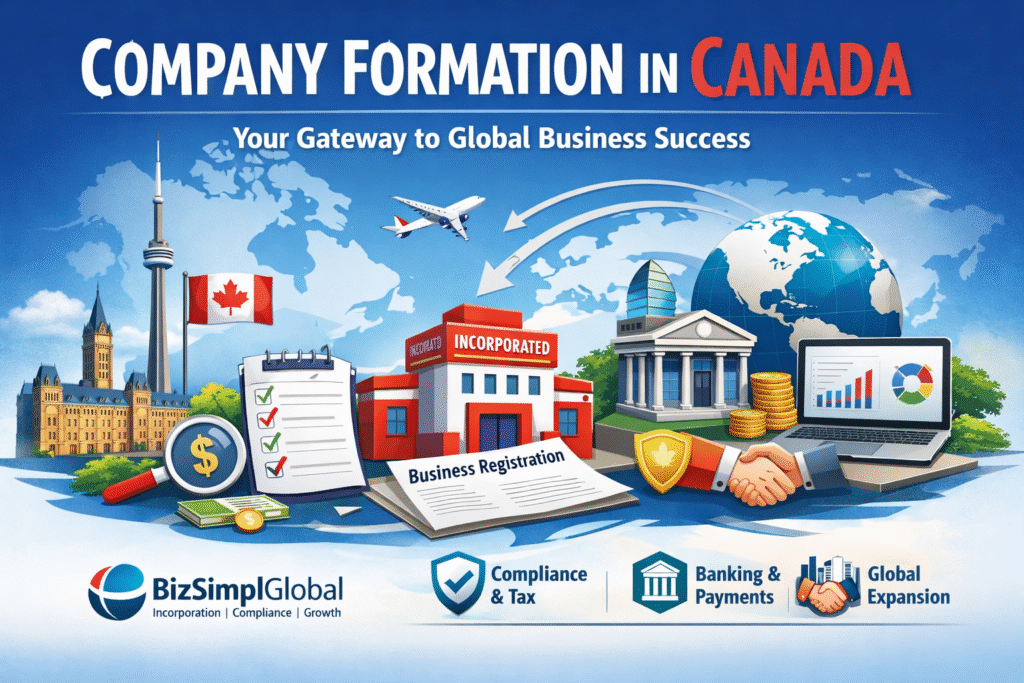
Company Formation in Canada is no longer just a North American market entry tactic—it has become a strategic lever for founders seeking regulatory credibility, global customer trust, and scalable international operations from day one. Canada offers political stability, transparent governance, and a business ecosystem that rewards compliance-led growth rather than aggressive loopholes.
This guide is written for founders who think beyond incorporation paperwork. It focuses on outcomes: bankability, long-term compliance, investor perception, and cross-border operability. The goal is not to rush registration—but to structure correctly the first time.
Why Company Formation in Canada Is Becoming a Global Founder Default
Global expansion is no longer optional for digital-first businesses, and Company Formation in Canada sits at the intersection of trust, access, and regulatory clarity. Canada consistently ranks among the top jurisdictions for ease of doing business while maintaining strong AML and corporate governance standards.
Unlike jurisdictions that optimize for anonymity or tax arbitrage, Canada optimizes for legitimacy. That matters when dealing with international clients, enterprise contracts, payment processors, and institutional investors. A Canadian entity signals operational seriousness without triggering excessive compliance friction.
For Asian and Indian founders in particular, Canada provides a rare balance: strong legal infrastructure with founder-friendly incorporation rules and realistic remote management pathways.
Who Should Choose Company Formation in Canada as Their Base Structure
Company Formation in Canada is not for every founder. It works best for specific profiles where regulatory trust and banking access matter more than short-term tax minimization.
SaaS founders targeting North American or EU clients benefit from Canadian data protection credibility and contract enforceability. Service agencies working with enterprise clients often find Canadian entities easier to onboard during vendor compliance checks.
Export-driven businesses and global freelancers also use Canada as a neutral, reputable billing jurisdiction—especially when dealing with USD or multi-currency clients.
Founders seeking venture capital or cross-border partnerships often prefer Canada because corporate structures align closely with US and UK investor expectations, without the aggressive scrutiny sometimes applied to offshore entities.
Company Formation in Canada: Federal vs Provincial Incorporation Clarity
A critical decision in Company Formation in Canada is whether to incorporate federally or at the provincial level. This choice impacts name protection, operational scope, and ongoing compliance.
Federal incorporation allows you to operate across all provinces under one legal identity, with nationwide name protection. It is ideal for businesses planning pan-Canadian operations or international branding consistency.
Provincial incorporation is simpler if your operations are concentrated in one province, such as Ontario or British Columbia. It can reduce initial complexity but may require extra registrations if you expand.
Both routes are governed by transparent processes overseen by Corporations Canada, with clearly defined filing obligations and timelines.
Company Formation in Canada Compared to Other Global Structures
When founders evaluate Company Formation in Canada, they often compare it with US LLCs, UK Limited companies, or UAE Freezone entities.
Canada differs fundamentally. It prioritizes substance over speed. There are no nominee shortcuts, and beneficial ownership disclosure is taken seriously. This reduces future banking and compliance friction.
Compared to US structures, Canada offers fewer state-level complexities and more predictable federal oversight. Compared to the UK, Canada has stronger banking stability and lower account freeze risk for foreign founders.
This makes Canada particularly attractive for founders who value long-term operational continuity over aggressive optimization.
Best Canadian Jurisdictions for Asian and Indian Founders
In practical Company Formation in Canada planning, Ontario and British Columbia dominate founder preference. Ontario provides proximity to financial institutions, fintech infrastructure, and North American clients.
British Columbia attracts technology and sustainability-driven businesses, with strong Asia-Pacific connectivity. Both provinces support remote founder management when compliance documentation is structured correctly.
Federal incorporation combined with provincial registration in these regions is a common strategy for founders who want flexibility without repeated restructuring.
Advisory firms like BizSimplGlobal help founders assess jurisdiction fit based on industry, banking goals, and future investor expectations—rather than generic popularity.
Company Formation in Canada by Industry Segmentation
Different industries extract different advantages from Company Formation in Canada, and structure should reflect operational reality.
SaaS companies benefit from strong IP protection frameworks and data governance alignment with EU and US standards. eCommerce businesses gain payment processor confidence and reduced account suspension risk.
Exporters leverage Canada’s trade agreements and reputation to simplify international contracting. Agencies and global freelancers use Canadian entities to bill enterprise clients without the stigma sometimes attached to offshore jurisdictions.
Each segment requires tailored documentation and compliance sequencing, not a one-size-fits-all setup.
Company Formation in Canada: Step-by-Step Formation Roadmap
A structured Company Formation in Canada roadmap reduces delays and prevents downstream compliance issues.
The process begins with name clearance or numbered corporation selection. This is followed by drafting articles of incorporation that reflect shareholder rights and future funding plans.
Director appointments, registered office setup, and share structuring come next. Once incorporated, the business must obtain a Business Number from Canada Revenue Agency for tax and payroll identification.
Firms like BizSimplGlobal focus on sequencing these steps to align with banking and payment gateway readiness, not just legal completion.
Global Document Checklist for Company Formation in Canada
Accurate documentation is the backbone of successful Company Formation in Canada. Founders must prepare identity proofs, address verification, and notarized disclosures that meet Canadian KYC standards.
Entity-level documents include incorporation certificates, articles, shareholder registers, and director resolutions. Any mismatch between founder documents and corporate filings can delay banking or trigger enhanced due diligence.
This is where global incorporation support becomes critical. BizSimplGlobal emphasizes zero-error filings and documentation harmonization across legal, tax, and banking layers.
Realistic Government Fees and Timelines for Company Formation in Canada
Company Formation in Canada is cost-transparent compared to many jurisdictions. Federal incorporation fees are moderate, with additional provincial registration costs if applicable.
Typical incorporation timelines range from a few business days for registration, followed by additional time for Business Number issuance and compliance registrations. Banking and payment gateway onboarding often take longer than incorporation itself.
Founders should budget not just for government fees, but for professional advisory that prevents costly rework later. Transparent pricing and risk-free onboarding are key indicators of a reliable partner.
Strategic Perspective Before You Proceed
Company Formation in Canada is not a checkbox exercise. It is a strategic infrastructure decision that influences how banks, clients, regulators, and investors perceive your business for years.
Founders who approach Canada with a compliance-first mindset gain durability, not just access. Those who rush without structure often face avoidable delays and operational friction.
BizSimplGlobal positions itself as a long-term incorporation and compliance guide—helping founders build entities that scale cleanly, bank smoothly, and withstand regulatory scrutiny.
Company Formation in Canada: Ongoing Compliance and Annual Obligations
Company Formation in Canada does not end with incorporation. Ongoing compliance is where many foreign founders either build long-term credibility or expose themselves to operational risk.
Every Canadian company must maintain annual filings, updated corporate records, and accurate tax reporting. Annual returns must be filed with the federal or provincial registry to keep the corporation in good standing. Failure leads to penalties or administrative dissolution.
Tax compliance revolves around the Business Number issued by Canada Revenue Agency. Depending on activity, this includes corporate income tax filings, GST/HST registrations, payroll remittances, and withholding compliance. Even dormant entities must file nil returns.
Director and shareholder changes must be formally recorded. Canada increasingly enforces beneficial ownership transparency, making accuracy critical. Compliance is predictable—but non-negotiable.
Company Formation in Canada and Remote Business Management Reality
A key advantage of Company Formation in Canada is that residency is not required for shareholders. Director residency requirements exist in certain provinces but can be managed through federal incorporation or compliant structuring.
Remote founders must ensure that decision-making records, board resolutions, and financial controls reflect substance. Canada does not tolerate shell behavior disguised as remote management.
Professional compliance oversight ensures that remote operations remain defensible during audits, banking reviews, or investor due diligence.
Company Formation in Canada: Remote Banking and Payment Gateway Access
One of the most misunderstood aspects of Company Formation in Canada is banking. Incorporation alone does not guarantee a bank account.
Canadian banks prioritize clarity of ownership, business model legitimacy, and transaction predictability. Foreign founders must be prepared for enhanced KYC and structured interviews.
Remote banking is possible, but only when documentation, source-of-funds clarity, and operational logic align. Fintech and EMI options exist, but traditional banks still carry the strongest credibility for scaling businesses.
Payment gateway access improves significantly with a Canadian entity, especially for SaaS, eCommerce, and subscription models. However, mismatched compliance narratives often cause rejections.
This is where BizSimplGlobal adds value—structuring the entity and documentation specifically for bank and gateway acceptance, not just legal completion.
Company Formation in Canada vs Banking Expectations in Other Jurisdictions
Unlike some jurisdictions that promise instant accounts, Company Formation in Canada operates on a trust-first model. Banks assess long-term risk, not short-term paperwork.
Compared to US banking, Canadian institutions are more conservative but more stable. Account freezes are rare when compliance is handled correctly. Compared to offshore jurisdictions, Canadian accounts enjoy higher international acceptance.
Founders must align expectations: Canada rewards patience and preparation with durable access.
Common Foreign-Founder Mistakes in Company Formation in Canada
The most common mistake in Company Formation in Canada is treating it like a low-friction offshore setup. Canada is not designed for anonymity or shortcuts.
Another frequent error is misaligned shareholding and control documentation, which raises red flags during banking reviews. Inconsistent addresses, vague business descriptions, and copied templates often trigger compliance delays.
Tax misunderstandings—especially around GST/HST thresholds and filing obligations—also cause penalties. These issues are avoidable with upfront advisory rather than reactive fixes.
Risk Prevention Strategies for Company Formation in Canada
Risk mitigation in Company Formation in Canada starts with precision. Every document must align across legal, tax, and banking layers.
Founders should implement proper accounting systems from day one, even before revenue begins. Clean books are not optional in Canada.
Regular compliance reviews, documented decision-making, and proactive filings prevent future disputes. Canada rewards founders who treat governance as infrastructure, not bureaucracy.
Why BizSimplGlobal Is a Strategic Partner for Company Formation in Canada
BizSimplGlobal is not a formation factory. Its value lies in advisory-driven execution for Company Formation in Canada and cross-border business setup.
The firm supports founders through global incorporation support, compliant documentation handling, and regulatory sequencing aligned with banking readiness. Its transparent pricing and zero-error filing approach reduce founder risk during the most vulnerable early stages.
BizSimplGlobal also advises on investor perception—structuring entities that look credible not just to regulators, but to partners and capital providers.
Company Formation in Canada: Expert Perspective on Long-Term Scalability
A well-executed Company Formation in Canada creates optionality. It allows founders to expand into the US, Europe, or Asia without re-incorporating or re-explaining credibility.
Canada’s regulatory predictability supports long-term planning. Compliance costs are stable, enforcement is transparent, and policy shifts are rarely abrupt.
Founders who build with Canada as a base often find it easier to raise capital, onboard enterprise clients, and operate globally without structural friction.
Key Takeaways for Future-Proof Company Formation in Canada
Company Formation in Canada is a credibility-first strategy, not a speed play.
Compliance accuracy determines banking and payment success.
Remote founders must prioritize substance and documentation alignment.
Canada rewards governance discipline with long-term stability.
Strategic advisory reduces risk far more than reactive fixes.
Frequently Asked Questions on Company Formation in Canada
Is Company Formation in Canada possible without visiting Canada?
Yes. Incorporation can be completed remotely. Banking may require additional verification, but travel is not mandatory if documentation and compliance narratives are strong.
Do I need to be a Canadian resident to own a company?
No. Shareholders can be non-residents. Director residency depends on the incorporation route and must be planned carefully.
How long does Company Formation in Canada take?
Incorporation itself is fast. Full operational readiness, including banking, typically takes several weeks depending on preparedness.
Is Company Formation in Canada suitable for startups seeking funding?
Yes. Canadian corporations are well understood by international investors and align with standard funding structures.
Are taxes high for Canadian companies?
Corporate tax rates are moderate and predictable. Compliance accuracy matters more than rate optimization.
Can I use Company Formation in Canada for global clients?
Yes. Canadian entities are widely accepted for international contracting and payments.
Is GST/HST registration mandatory immediately?
Only once revenue thresholds are met. Early registration may be strategic depending on the business model.
What industries benefit most from Company Formation in Canada?
SaaS, eCommerce, exporters, agencies, and global service providers benefit the most.
Does Canada share banking data internationally?
Canada participates in international information exchange frameworks but maintains strong data governance.
Is professional advisory necessary for Company Formation in Canada?
For foreign founders, yes. It significantly reduces compliance risk and operational delays.
Growth-Focused Closing
Company Formation in Canada is a long-term infrastructure decision. Founders who approach it with clarity, compliance discipline, and strategic advisory build businesses that scale without friction.
If your goal is sustainable global expansion—not shortcuts—BizSimplGlobal provides the structured guidance required to execute Canada correctly and confidently.

The Definitive Guide to Company Formation in Canada for Foreign Founders: Scaling Globally with Strategic Compliance
Company Formation in Canada has emerged as the premier pathway for ambitious founders looking to bridge the gap between North American market access and a…

The Definitive Guide to Company Formation in USA: A Strategic Roadmap for Global Founders
The Strategic Necessity of Company Formation in USA for Modern Global Enterprises Company Formation in USA has transitioned from a luxury milestone for elite startups…

The Ultimate Guide to LLC Formation in Canada for Foreign Founders: Strategy, Compliance, and Growth
The Strategic Blueprint for LLC Formation in Canada LLC Formation in Canada represents a unique and powerful strategic pivot for entrepreneurs looking to establish a…